Note: Click on Solar System Exploration: Galileo Legacy Site (NASA-JPL) to get this image at its highest resolution.
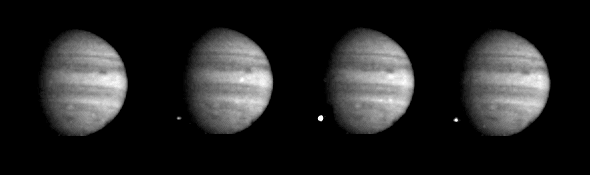
These four images of Jupiter and the impact of fragment W of Comet Shoemaker-Levy/9 were taken at intervals of 2 1/3 seconds.
The first image (left), shows no impact.
In the next three images, a point of light appears (left of Jupiter's terminator),
brightens so much as to saturate its picture element, and then fades, seven seconds after the first picture.
July 22, 1994. Range, 238 million kilometers (148 million miles).
While most of the observations of Comet Shoemaker-Levy/9's collision with Jupiter were made from Earth or Earth-orbiting observatories,
Galileo had the best seat in the house.
Only Galileo was able to directly see the crash sites;
from the Earth, the collision site was on Jupiter's back side, out of our direct view.
The location is approximately 44 degrees south as predicted; dark spots to the right are from previous impacts.
Jupiter is approximately 60 picture elements in diameter.
The images were taken using the green filter (visible light).
Galileo tape-recorded most of its observations of the Shoemaker-Levy impacts and played the tape back selectively.
Scientists now believe that the point of light in this picture and other Galileo data
shows the effects of the meteor bolides (the comet fragments entering Jupiter's atmosphere)
and is not related to the subsequent explosion and fireball.
Once all the Galileo, Hubble Space Telescope and ground-based data are combined,
an excellent start-to-finish characterization of these remarkable phenomena will be available.
Preliminary data analyses from three of Galileo's instruments indicated
that one of the SL9 fragments exploded into a 7-km (4-mile)-diameter fireball.
This Fragment G fireball on July 18 1994,
when first detected by the Ultraviolet Spectrometer (UVS) and Photopolarimeter-Radiometer (PPR),
was about 7,600 degrees Kelvin (13,000 degrees Fahrenheit), which is hotter than the Sun's surface.
Five seconds later, the Near-Infrared Mapping Spectrometer (NIMS) detected it,
recording the fireball's expansion, rise, and cooling for a minute and a half,
until it was hundreds of kilometers across and only about 400 K (260 deg F).
Galileo has thus provided a unique data set on SL9, that is,
the only profile of the size and temperature of the fireball during the first few minutes following the impact itself.
Based on NIMS data, we know that the super hot fireballs associated with fragments G and R
lasted about 1 minute (before cooling sufficiently to be invisible to NIMS).
We also know (from NIMS) that the plume ejecta began falling back into the atmosphere
about 6 minutes later, getting brighter and brighter for the 3 minutes observed.
Ground-based data indicate that the total splash phase for each of the two fragments lasted about 10 minutes,
with peak brightness reached at about 5 minutes after initial detection.
The ejecta exploded out of the atmosphere at a minimum vertical velocity of 4.3 km/s (~9,300 mph),
with particles reaching at least 380 km (228 miles) high!
Galileo may help answer many questions about the collision. For example, what was the size of the comet fragments? Were they large, several kilometers in diameter, as some predicted? Or were they much smaller - only half a kilometer across - or even just loosely held-together piles of rubble or wisps of dust?
A related question is how deeply the comet pieces penetrated into Jupiter's atmosphere before exploding.
Single, large, solid fragments would have been expected to penetrate further and bring up water
from Jupiter's presumed water-rich atmospheric layers,
while rubble piles or rubble swarms might only have caused meteor storms in the upper atmosphere with no deep penetration.
Preliminary spectroscopic data imply that the fragments did not penetrate very deeply,
since little or no water was splashed up into the stratosphere.
Another interesting question is why Jupiter's icy satellite Europa did not reflect the bright flashes from the dark side of Jupiter,
as expected.
Europa's shadowed,
reflective, icy surface should have served as an excellent mirror for the brilliant flashes and subsequent glowing fireballs.
But it didn't happen that way.
Galileo may be best able to answer questions about optical flashes.
Perhaps the most perplexing question is what caused those immense black patches to remain in Jupiter's high atmosphere.
The largest patches are bigger than the whole planet Earth and much darker and more prominent than the Great Red Spot.
Initially, they were expected to fade and disappear in a few days,
but they persisted for months afterwards - even a year in some wavelengths.
Conceivably, as Galileo nears its target, it will also be able to help explain these aspects of the SL9 impacts at Jupiter.
First slide: Launch of Galileo on STS-34 Atlantis
Back: Galileo To Jupiter
Link to: Solar System Exploration: Galileo Legacy Site (NASA - JPL)
Updated: December 1 '96
Best seen with MS Internet Explorer.
Back: ARVAL - Image Gallery
Messages: