Previous: Planets Up: The Solar System Next: Solar System Data
Royal Greenwich Observatory
_________________________________________________________
Information Leaflet No. 51: 'Orbits'
Orbits:
Until Isaac Newton formulated his Laws of Motion it was generally thought
that to keep a body in motion it was necessary to use a force to push or pull it.
This accorded well with everyday experience where things came to a halt after the moving force was removed.
Galileo made a set of experiments
that led him to believe that movement was an intrinsic property that needed no maintenance
and Newton based his theory of motion on this concept.
(In our normal experience movement is slowed by friction or air resistance
which are forces which have to be balanced by a motive force to maintain motion).
Newton's Laws of Motion are;
From these three simple laws all the motions of bodies acted on by forces can be derived.
Newton himself applied his laws to the motion of the Moon and the planets.
He realized that the force of gravity was the force that controlled the planets and the Moon in their orbits around the Sun and the Earth.
A simple experiment can be used to demonstrate the principles of gravitationally bound orbits.
Take a piece of string about 1-2 metres long and securely tie a fairly heavy object to one end.
Go into an open area, where no harm can come to anything when the heavy object flies out of your hand!
If you hold the other end of the string, and whirl it around your head, you will notice several things:
First, you will feel that the string is pulling against you, and the faster you whirl the stronger the pull.
Also, you will note that if you let go of the string, the weight will immediately fly off at a tangent, in a straight line.
This simple experiment demonstrates Newton's first law; when you are not exerting a force on the weight it travels in a straight line.
Also, the third law; you are pulling on the weight via the string and the weight is also pulling you.
It also demonstrates how a planet is controlled by the gravitational pull of the Sun.
The speed of the weight determines the force exerted by the string.
This is equivalent to the speed of a planet in its orbit being determined by the gravitational pull of the Sun.
The closer a planet is to the Sun, the greater the gravitational pull, and so the faster the planet must move to stay in an orbit.
ARVAL's Note:
Newton's law of Universal Gravitation is:
The gravitational interaction between two bodies, can be expressed by an attractive central force proportional to the masses of the bodies, and inversely proportional to the square of the distance between them.
F = G × m1 × m2 / r2
Where G is approximately equal to 6.674 × 10⁻¹¹ N × m2 × kg-2
F is measured in newtons (N), m1 and m2 in kilograms (kg), r in meters (m)
The planets do not, however, move in circular orbits.
Newton showed that the laws derived by Kepler were in accord with his theory
and indicated that the planets move in elliptical orbits about the Sun.
Nowadays we can observe the orbits very exactly and we can take into account not only the gravitational pull of the Sun,
but also the much smaller pulls of each of the other planets.
These effects make the paths of the planets depart slightly from the classical ellipses described
by the simplification of considering only the pull of the Sun.
ARVAL's Note:
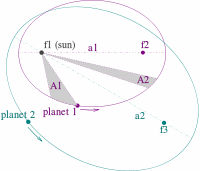
Kepler's laws are:
1. The orbits are ellipses, with focal points f1 and f2 for the first planet and f1 and f3 for the second planet.
The Sun is placed in focal point f1.
2. The two shaded sectors A1 and A2 have the same surface area and the time for planet 1 to cover segment A1
is equal to the time to cover segment A2.
3. The total orbit times for planet 1 and planet 2 have a ratio a13/2 : a23/2.
From Kepler's laws of planetary motion (Wikipedia)
The orbit of the Moon is especially complex because the pull of the Earth and that of the Sun are not too dissimilar.
It is a surprise to many that the path of the Moon about the Sun is always curved in the same way, concave towards the Sun,
and is nowhere looped or even convex towards the Sun.
This despite the fact that we know that is is orbiting the Earth each month.
One of the great achievements of Newton's theory,
was the determination by Halley that comets moved in either parabolic or elliptical orbits.
He calculated the orbits of many comets and showed that several supposed different comets followed the same orbit.
He conjectured that they were one and the same object, and further predicted that it would reappear in a stated year.
We now call this comet by Halley's name in honour of the fact that his analysis and his prediction were right.
In the modern era, there are many artificial satellites in orbit around the Earth,
and space probes visiting the different planets and satellites in the Solar System.
The calculation of their orbits and the path of the space probes is a complex adaptation of the theory as derived by Newton.
In the same way as the Earth is in orbit around the Sun, the Sun is in an orbit around the centre of our galaxy, the Milky Way.
The time taken for one revolution is very long, about 200,000,000 years, and the diameter of the orbit is about 60,000 light years.
Glossary of terms:
Perigee and Apogee. These are the minimum and maximum distances from the Earth of a satellite or other body.
Perihelion and Aphelion are the minimum and maximum distances from the Sun of a planet or other body.
Eccentricity of an orbit is a measure of how far from a circle the shape appears.
For a circular orbit the eccentricity, (e), is zero, for a parabolic orbit e=1, while a hyperbolic orbit has e greater than 1.
Elliptical orbits have their eccentricities greater than zero, but smaller than 1.
Nodes of an orbit are the places where the orbit intersects some fundamental plane.
For example, the nodes of the Moon's orbit about the Earth, occur where its orbit crosses the Earth's orbital plane about the Sun.
The Moon must be close to one of its nodes at New or Full Moon, for an eclipse of the Sun or Moon to take place.
Geosynchronous orbits, are the ones where an artificial satellite in orbit around the Earth, has a period of exactly one day.
This means that it is always above the same place on the Earth's equator.
For satellites in orbit at about 100 miles above the surface, the period of revolution is close to 90 minutes.
As the height of the orbit above the Earth is increased, so the strength of the Earth's gravitational pull decreases,
the speed of the satellite slows, and its period of revolution increases.
At a height of 35,900 km, the orbital period of the satellite in a circular orbit is one day,
and so it remains above the same point on the Earth's equator. We call this a geostationary or geosynchronous orbit.
Produced by the Information Services Department of the Royal Greenwich Observatory.
PJA Tue May 8 16:10:38 GMT 1996
webman@mail.ast.cam.ac.uk
 Updated: March 23 '97, August 22 '13, June 24 '14
Best seen with Font Verdana.
See About the Web Pages of Observatorio ARVAL.
Back: ARVAL - RGO Leaflets - The Solar System
Messages: