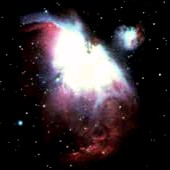
Located 1,500 light-years away, along our spiral arm of the Milky Way,
the Orion Nebula is located in the middle of The Sword region of the constellation Orion the Hunter,
which dominates the early winter evening sky, at northern latitudes.
The stars have formed from collapsing clouds of interstellar gas within the last million years.
The most massive clouds have formed the brightest stars near the center and these are so hot that
they illuminate the gas left behind after the period of star formation was complete.
The more numerous faint stars are still in the process of collapsing under their own gravity,
but have become hot enough in their centers to be self luminous bodies.
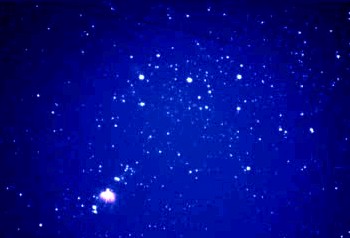
The photograph shows the 3 stars on the "Belt" of Orion, and the "Sword", lower and to the left.
(Northeast up, Southeast to the Left)
Because the Orion star cluster is less than a million years of age,
there has not been enough time for planets to agglomerate from the dust within the disks.
Many of the stars are still contracting towards the mature status that they will then retain for billions of years.
The most massive stars in the cluster have already reached their adult stage of maximum hydrogen fuel burning
and their surfaces have become so hot that their radiation heats up the gas left over after star formation.
This is visible to observers with binoculars as the Orion Nebula, which is in the middle of the region known as The Sword of Orion.
Note:
The word Proplyd (from Proto-Planetary Disk) is an invention
of the American astrophysicist C. Robert O'Dell. from Rice University.
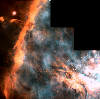
This is one of the nearest regions of very recent star formation (300,000 years ago).
The nebula is a giant gas cloud illuminated by the brightest of the young hot stars at the bottom-right of the picture.
Many of the fainter young stars are surrounded by disks of dust and gas
that are slightly more than twice the diameter of the Solar System.
A Hubble Space Telescope view of a small portion of the Orion Nebula reveals five young stars.
Four of the stars are surrounded by gas and dust trapped as the stars formed, but were left in orbit about the star.
These are possibly protoplanetary disks, or "proplyds", that might evolve on to agglomerate planets.
Press Release No.: STScI-PR94-24, June 13, 1994
NASA announced today that a Rice University astronomer using the Hubble Space Telescope has uncovered the strongest evidence yet that the process which may form planets is common in the Milky Way galaxy, of which Earth is a part, and the universe beyond.
Hubble Space Telescope's detailed images confirm more than a century of speculation, conjecture, and theory about the genesis of a solar system.
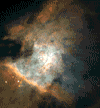
This spectacular color panorama of the center the Orion nebula
is one of the largest pictures ever assembled from individual images taken with NASA's Hubble Space Telescope.
The picture, seamlessly composited from a mosaic of 15 separate fields,
covers an area of sky about five percent the area covered by the full Moon.
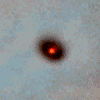
These are Hubble Space Telescope images of four newly discovered protoplanetary disks around young stars in the Orion nebula,
located 1,500 light-years away.
Gas and dust disks, long suspected by astronomers to be an early stage of planetary formation,
can be directly seen in visible light by Hubble.
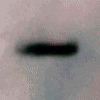
Resembling an interstellar Frisbee, this is a disk of dust seen edge-on around a newborn star in the Orion nebula,
located 1,500 light-years away.
Because the disk is edge-on, the star is largely hidden inside, in this striking Hubble Space Telescope picture.
The disk may be an embryonic planetary system in the making.
Our Solar System probably formed out of just such a disk 4.5 billion years ago.
At 17 times the diameter of our own Solar System,
this disk is the largest of several recently discovered in the Orion nebula.
Note to Editors, November 20, 1995
Astronomers are releasing today one of the largest pictures ever taken of the heavens with NASA's Hubble Space Telescope -- a spectacular color panorama of the center of the Orion nebula, a star forming region located 1,500 light-years away in the constellation of Orion the Hunter.
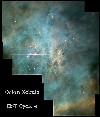
An extended view of the Trapezium showing the four energetic massive stars
and a plethora of Sun-like stars with surrounding extended emission.
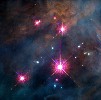
The center of the Trapezium cluster showing the four massive energetic stars and a number of evaporating proto-planetary disks.
Press Release: January 14, 1997
Theoretical models, coupled with NASA Hubble Space Telescope observations of the Trapezium cluster in the Orion Nebula, suggest that disks around young cluster stars may not survive long enough for planets to form within them.

January 11, 2006 (STScI-2006-01)
In one of the most detailed astronomical images ever produced,
NASA's Hubble Space Telescope captured an unprecedented look at the Orion Nebula.
This turbulent star formation region is one of astronomy's most dramatic and photogenic celestial objects.
More than 3,000 stars of various sizes appear in this image. Some of them have never been seen in visible light.
These stars reside in a dramatic dust-and-gas landscape of plateaus, mountains, and valleys that are reminiscent of the Grand Canyon.
The Orion Nebula is a picture book of star formation, from the massive, young stars that are shaping the nebula
to the pillars of dense gas that may be the homes of budding stars.
 Updated: January 13 '06
Best seen with MS Internet Explorer.
And a display showing 16 millon colors (24 or 32 bits/pixel).
Back: Observatorio ARVAL - Image Gallery The Orion Nebula
Messages: