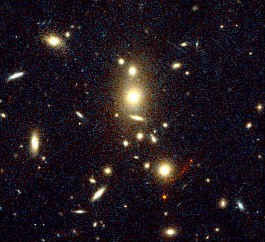
 A NASA Hubble Space Telescope image of the galaxy cluster CL1358+62
has uncovered a gravitationally-lensed image of a more distant galaxy located far beyond the cluster.
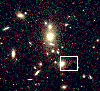
A NASA Hubble Space Telescope image of the galaxy cluster CL1358+62
has uncovered a gravitationally-lensed image of a more distant galaxy located far beyond the cluster.
A NASA Hubble Space Telescope image of the galaxy cluster CL1358+62
has uncovered a gravitationally-lensed image of a more distant galaxy located far beyond the cluster.
The gravitationally-lensed image appears as a red crescent to the lower right of center.
The galaxy's image is brightened, magnified,
and smeared into an arc-shape by the gravitational influence of the intervening galaxy cluster, which acts like a gigantic lens.
 Exact measurement of the distance from spectroscopic observations with the W. M. Keck Observatory in Hawaii,
show the lensed galaxy is the farthest ever seen.
Its light is only reaching us now from a time when the universe was but 7% its current age of approximately 14 billion years.
This places the young galaxy as far as 13 billion light-years away.
The lensing foreground cluster is 5 billion light-years from us.
Exact measurement of the distance from spectroscopic observations with the W. M. Keck Observatory in Hawaii,
show the lensed galaxy is the farthest ever seen.
Its light is only reaching us now from a time when the universe was but 7% its current age of approximately 14 billion years.
This places the young galaxy as far as 13 billion light-years away.
The lensing foreground cluster is 5 billion light-years from us.
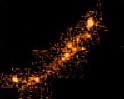 A close-up of the gravitationally-lensed image
shows why astronomers are excited about this unique opportunity to study the distant galaxy's structure.
The stretched-out image reveals tiny knots of vigorous starbirth activity.
This provides a first detailed look at the early construction phase of a galaxy undergoing formation.
A close-up of the gravitationally-lensed image
shows why astronomers are excited about this unique opportunity to study the distant galaxy's structure.
The stretched-out image reveals tiny knots of vigorous starbirth activity.
This provides a first detailed look at the early construction phase of a galaxy undergoing formation.
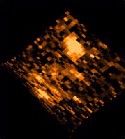 A theoretical model of the cluster lens is used to "unsmear" the gravitationally-lensed image back into the galaxy's normal appearance.
The corrected image gives a highly magnified view of the distant galaxy with detail 5-10 times smaller than Hubble alone can provide.
It clearly shows several bright, very compact regions of intense star formation.
These starburst regions are some 700 light-years across.
The knots are so bright they indicate bursts of star formation taking place at a much faster rate
than seen in most galaxies at the present time.
A theoretical model of the cluster lens is used to "unsmear" the gravitationally-lensed image back into the galaxy's normal appearance.
The corrected image gives a highly magnified view of the distant galaxy with detail 5-10 times smaller than Hubble alone can provide.
It clearly shows several bright, very compact regions of intense star formation.
These starburst regions are some 700 light-years across.
The knots are so bright they indicate bursts of star formation taking place at a much faster rate
than seen in most galaxies at the present time.
The image was taken with Hubble's Wide Field Planetary Camera-2 on January 13, 1996.
The true color rendition was created from separate exposures taken through a red and a near-infrared filter (the F606W and F814W filters).
The top image is 64 arcseconds wide, that on the middle is 10 arcseconds wide, while the lower one is only 2 arcseconds wide.
Credits:
Marijn Franx (University of Groningen, The Netherlands),
Garth Illingworth (University of California, Santa Cruz), and NASA
Jonathan Eisenhamer -- eisenham@stsci.edu
Questions & Answers (About this discovery)
Higher-resolution versions of these images can be obtained at:
World's Most Powerful Telescopes Team Up With A Lens In Nature To Discover Farthest Galaxy In The Universe
Astronomers have pushed NASA's Hubble Space Telescope to its limits by finding
what is likely to be the most distant object ever seen in the universe.
The object's light traveled 13.2 billion years to reach Hubble, roughly 150 million years longer than the previous record holder.
See NASA's Hubble Finds Most Distant Galaxy Candidate Ever Seen in Universe
Updated: August 10 '97, January 30 '11
Best seen with MS Internet Explorer.
Back to ARVAL's Gallery (Most Distant Galaxy In The Universe)
Messages: