The Cosmic Microwave Background, accidentally detected in 1964 by Arno Penzias and Robert Wilson, is widely believed to be the radiation remnant of the Big Bang; The origin of the Universe, postulated by Georges-Henry Lamaître between 1927 and 1933. The Cosmic Microwave Background was predicted in 1948 by Ralph Alpher and Robert Herman, they calculated that it should have by now cooled down to some 5° Kelvin (0°K = -273°C, 5°K = -268°C).
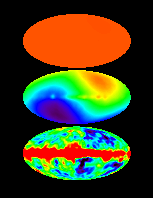
The images below were created from the Cosmic Background Explorer (COBE) satellite's Differential Microwave Radiometers (DMR) 4-year data products.
In the images, the blue and red spots correspond to regions of greater or lesser density in the early Universe, 300,000 years after the Big Bang itself. These relics record the distribution of matter and energy in the early Universe, before the matter became organized into stars and galaxies.
While the initial discovery of variations in the intensity of the CMB (made by COBE in 1992) was based on a mathematical examination of two years of data, the new picture of the sky from the full four-year mission gives an accurate visual impression of the data.
These maps have been smoothed with a 7 degree beam, giving an effective angular resolution of 10 degrees.
At this angular scale, the signal-to-noise ratio is sufficient (~2 per 10 degree patch)
to portray for the first time an accurate visual impression of the Cosmic Microwave Background (CMB) anisotropy.
An all-sky image in Galactic coordinates is plotted using the equal-area Mollweide projection.
The plane of the Milky Way Galaxy is horizontal across the middle of each picture.
Sagittarius is in the center of the map, Orion is to the right and Cygnus is to the left.
The image represents DMR data from the 53 GHz band on a scale from 0° to 4°K,
showing the near-uniformity of the Cosmic Microwave Background (CMB) brightness (top),
then on a scale intended to enhance the contrast due to the dipole component (middle),
and following subtraction of the dipole component (bottom).
The dipole, a smooth variation between relatively hot and relatively cold areas, from the upper right to the lower left,
is due to the motion of the Solar System relative to distant matter in the Universe.
The signals attributed to this variation are very small, only one thousandth the brightness of the sky.
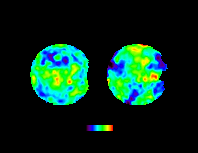
This is the COBE-DMR "Map of the Early Universe".
This false-color image shows tiny variations in the intensity of the Cosmic Microwave Background
measured in four years of observations by the Differential Microwave Radiometers (DMR) on the NASA's Cosmic Background Explorer (COBE).
The features traced in this map stretch across the visible Universe:
The largest features seen by optical telescopes, such as the "Great Wall" of galaxies,
would fit neatly within the smallest feature in this map. (Caption courtesy of Dr. Charles L. Bennett)
The COBE datasets were developed by the NASA Goddard Space Flight Center
under the guidance of the COBE Science Working Group and were provided by the
National Space Science Data Center (NSSDC).
Outside ARVAL's Web site:
Main sources for these pages:
Recent Research:
Others:
First Direct Evidence of Cosmic Inflation
Cambridge, MA - Almost 14 billion years ago, the universe we inhabit burst into existence in an extraordinary event that initiated the Big Bang. In the first fleeting fraction of a second, the universe expanded exponentially, stretching far beyond the view of our best telescopes. All this, of course, was just theory.
Researchers from the BICEP2 collaboration today announced the first direct evidence for this cosmic inflation. Their data also represent the first images of gravitational waves, or ripples in space-time. These waves have been described as the "first tremors of the Big Bang". Finally, the data confirm a deep connection between quantum mechanics and general relativity.
These groundbreaking results came from observations by the BICEP2 telescope of the cosmic microwave background -- a faint glow left over from the Big Bang. Tiny fluctuations in this afterglow provide clues to conditions in the early universe. For example, small differences in temperature across the sky show where parts of the universe were denser, eventually condensing into galaxies and galactic clusters.
Since the cosmic microwave background is a form of light, it exhibits all the properties of light, including polarization. On Earth, sunlight is scattered by the atmosphere and becomes polarized, which is why polarized sunglasses help reduce glare. In space, the cosmic microwave background was scattered by atoms and electrons and became polarized too.
"Our team hunted for a special type of polarization called 'B-modes', which represents a twisting or 'curl' pattern in the polarized orientations of the ancient light", said co-leader Jamie Bock (Caltech/JPL).
Gravitational waves squeeze space as they travel, and this squeezing produces a distinct pattern in the cosmic microwave background. Gravitational waves have a "handedness", much like light waves, and can have left- and right-handed polarizations.
"The swirly B-mode pattern is a unique signature of gravitational waves because of their handedness. This is the first direct image of gravitational waves across the primordial sky", said co-leader Chao-Lin Kuo (Stanford/SLAC).
The team examined spatial scales on the sky spanning about one to five degrees (two to ten times the width of the full Moon). To do this, they traveled to the South Pole to take advantage of its cold, dry, stable air.
"The South Pole is the closest you can get to space and still be on the ground", said Kovac. "It's one of the driest and clearest locations on Earth, perfect for observing the faint microwaves from the Big Bang".
They were surprised to detect a B-mode polarization signal considerably stronger than many cosmologists expected. The team analyzed their data for more than three years in an effort to rule out any errors. They also considered whether dust in our galaxy could produce the observed pattern, but the data suggest this is highly unlikely.
"This has been like looking for a needle in a haystack, but instead we found a crowbar", said co-leader Clem Pryke (University of Minnesota).
When asked to comment on the implications of this discovery, Harvard theorist Avi Loeb said, "This work offers new insights into some of our most basic questions: Why do we exist? How did the universe begin? These results are not only a smoking gun for inflation, they also tell us when inflation took place and how powerful the process was".
Release No.: 2014-05
For Release: Monday, March 17, 2014 - 10:45am (Harvard-Smithsonian Center for Astrophysics - CfA)
From:
Also see:
Gravitational Waves Detected 100 Years After Einstein's Prediction:
For the first time, scientists have observed ripples in the fabric of spacetime called gravitational waves, arriving at the Earth from a cataclysmic event in the distant universe. This confirms a major prediction of Albert Einstein's 1915 general theory of relativity and opens an unprecedented new window onto the cosmos.
Gravitational waves carry information about their dramatic origins and about the nature of gravity that cannot otherwise be obtained. Physicists have concluded that the detected gravitational waves were produced during the final fraction of a second of the merger of two black holes to produce a single, more massive spinning black hole. This collision of two black holes had been predicted but never observed.
From:
 Updated: October 3 '06, October 4 '11, March 18 '14, February 12 '16
Back to: ARVAL's Gallery (The Cosmic Microwave Background - A Relic from the Origin of the Universe)